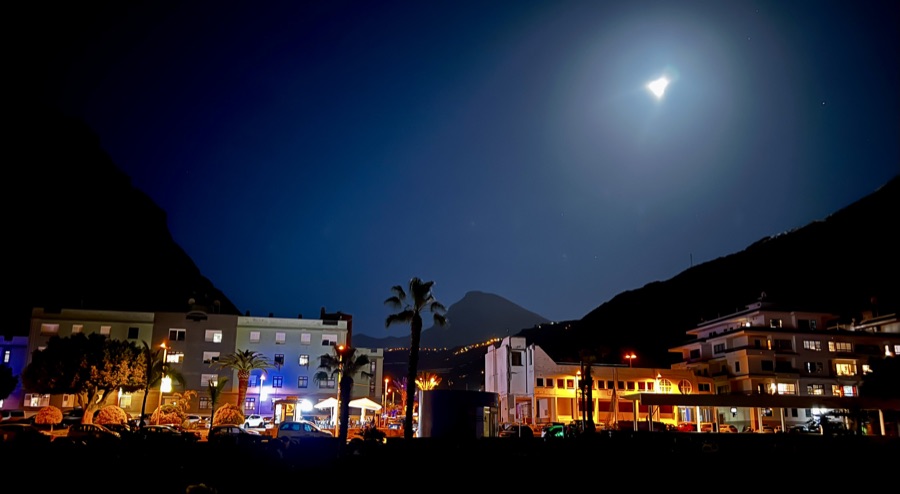
I have lived under a lot of night skies. None of them prepared me for the first time I really looked up on La Palma. The Milky Way was not a faint smudge, it was a bright band thrown right across the sky, with shooting stars and planets you could pick out with the naked eye. If you do one thing here after dark, make it this.
Here is how to do stargazing on La Palma properly: where to go, how to get inside the observatory, and how to book a tour under the stars.
Why the sky here is so absurdly good
La Palma was the first place on earth to be named a UNESCO Starlight Reserve, and once you are here it is obvious why. Three things line up:
- Height. The summit at Roque de los Muchachos is 2,426 m, which puts you above the clouds and most of the haze.
- The sea of clouds. A layer of low cloud often sits below the peaks, trapping moisture and the few lights there are underneath it.
- The law. The island actually has a “Sky Law” limiting outdoor lighting to protect the telescopes. The darkness here is defended on purpose.
Put those together and you get one of the cleanest skies on the planet, which is exactly why the world’s astronomers built up here.
Going inside the observatory (do this, even by day)
On the summit sits a cluster of giant white domes, including the Gran Telescopio Canarias, the largest single-mirror optical telescope in the world. You cannot just walk in, but there are guided daytime tours, and they are worth it even if you are not an astronomy nerd.
- When: mornings only, booked in advance
- Price: around 20 euros, usually with a discount at the visitor centre thrown in
Here is the part that got me. You go inside one of the great domes and watch the telescope move. This thing is tens of metres across and weighs hundreds of tonnes, and yet it is balanced so finely, with so little friction, that in theory a single person could push it round. Watching that much engineering turn that smoothly is genuinely jaw-dropping. The guides also tell you what life is actually like up here: how astronomers from all over the world apply for their slice of observing time, how long the waiting lists run, the small daily details of working at one of the most important sites in astrophysics. It turns a viewpoint into a story.
And even if you skip the tour, just drive up by day. The view back over the Caldera and the sea of clouds is something else.
The night tour: actually looking at the stars
The daytime visit is about the science. To actually lie back and look at the sky, you want a guided stargazing tour after dark, and it is the most popular evening thing on the island for good reason.
A good one includes transport up the mountain, a guide or astronomer, and proper telescopes pointed at planets, clusters, nebulae and far-off galaxies, while someone walks you through the constellations with a laser. For a lot of people it is the highlight of the whole trip. They are small groups and they fill up fast in summer, so booking ahead online is the safe move.
Where to go if you are doing it yourself
You do not have to drive all the way to the top. Good spots include:
- Roque de los Muchachos, the ultimate place, right by the observatory. Cold and high, so come prepared.
- Llano del Jable, a black volcanic plateau in the south that the astrophotographers love.
- The El Pilar area, easier to reach and still beautifully dark.
- Fuencaliente in the far south, low light and clear horizons out to sea.
A few hard-won tips
- Avoid the full moon. A bright moon washes out the stars, and tours often do not run on those nights. Check the moon before you plan.
- Dress for winter, even in August. It is genuinely cold at 2,400 m at night. Warm jacket, long trousers, closed shoes. Every time.
- The drive is long, dark and twisty. Give yourself time, or take a tour with transport so someone else does the hairpins. You will want your own transport for the island anyway.
- Let your eyes adjust. Give it twenty minutes away from any light, and use a red torch instead of your phone.
When to go
Clear nights are common all year up here, so there is no bad season. New moon gives the darkest skies, summer brings the bright heart of the Milky Way, and you have a decent shot at clear views during the big meteor showers.
Make a day and a night of it
Stargazing pairs perfectly with a daytime trip into the Caldera de Taburiente, since it is all the same mountain. For everything else to fill your days, have a look at our guide to the best things to do on La Palma, and go plan the trip of a lifetime under the stars.
Leave a Reply