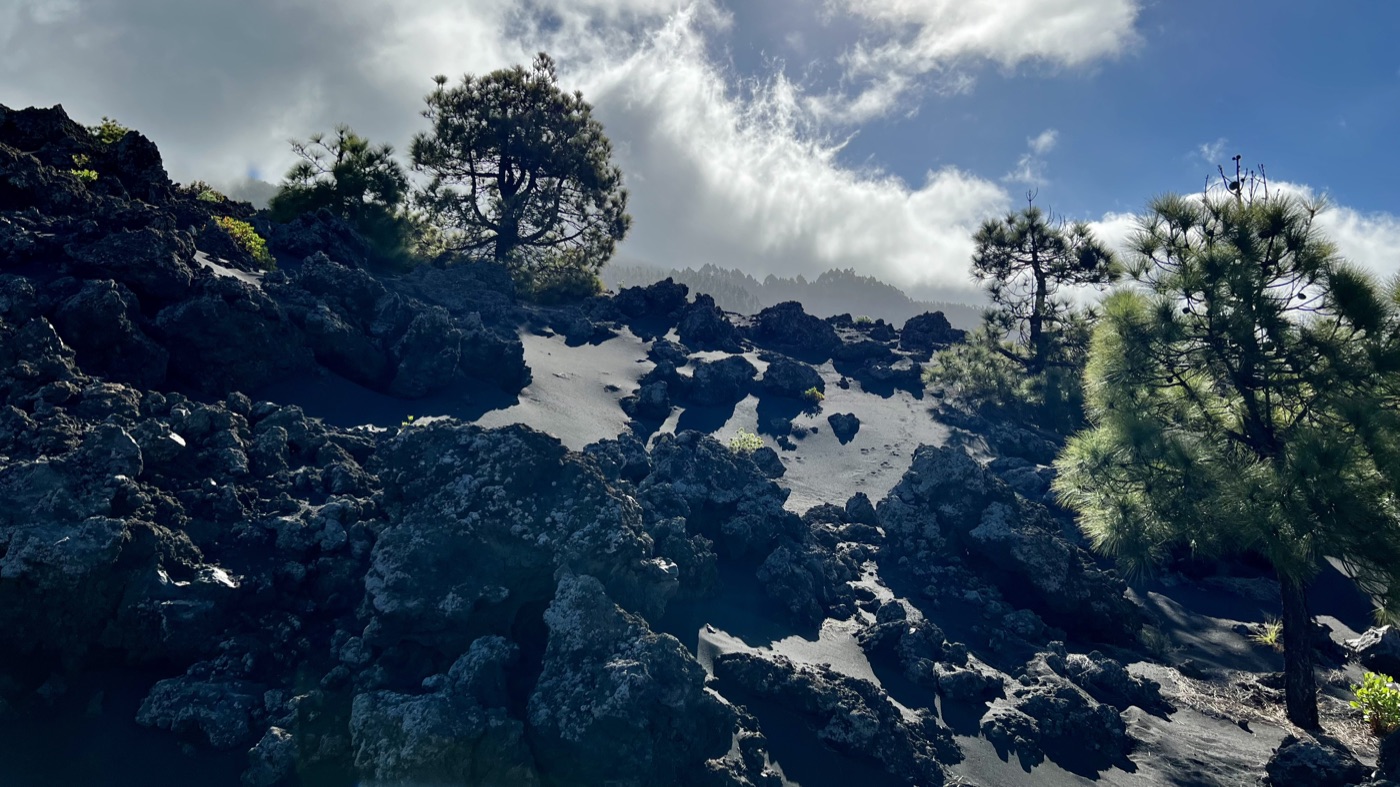
Every kid who grows up here knows the name Tanausú. It is on streets and hotels and statues, and it comes up at fiestas. But a lot of visitors never hear it, which is a shame, because his story is the story of this island, and it is woven into the very landscape you will hike through.
Long before any Spanish ship appeared, La Palma had its own name, Benahoare, “my homeland”, and its own people. Tanausú was the last of their great chiefs, and he made his final stand inside the giant crater we now call the Caldera de Taburiente.
Who were the Benahoaritas?
The first people of La Palma are usually called the Benahoaritas (also Awara). They were part of the wider Guanche world of the Canaries, descended from North African Berbers who reached the islands more than two thousand years ago. They lived in caves and stone shelters, kept goats, gathered shellfish, and carved those strange spiral engravings you can still see at places like La Zarza. Before the conquest the island was split into twelve small chiefdoms, each with its own leader. One of them was Aceró, a name thought to mean “strong”, and it covered the hardest ground on the island: the great crater at its heart.
Tanausú, the stubborn one
Tanausú was the chief of Aceró, and his name has been translated as “the stubborn one”. He earned it. When the Castilian conquest began in 1492, several other La Palma chiefs gave in fairly quickly. Tanausú did not. His advantage was the ground he stood on. Aceró was the Caldera de Taburiente, a ring of cliffs up to 2,000 m high that you can only enter through a few narrow ravines. From inside that natural fortress, he and his people held out.
The conquest, and a dirty trick
The conquest was led by Alonso Fernández de Lugo, who landed in 1492 and founded what became Santa Cruz de La Palma. Most of the island fell within months. The Caldera did not. Every push into the crater got thrown back by defenders who knew every rock.
So Fernández de Lugo stopped trying to win and decided to cheat. He sent a Christianised relative of the chief, Juan de Palma, to offer peace talks at the pass of Adamacansis. Tanausú believed it, came down from the Caldera with his men, and walked straight into an ambush. He was captured, and with him the last real resistance on La Palma collapsed in 1493.
Vacaguaré: I want to die
They put him on a ship to Spain, to be shown off at the Castilian court. He never arrived. The chronicles say he refused all food and kept repeating one word, vacaguaré, “I want to die”, and starved himself rather than live as a prize. He died somewhere out on the crossing.
That is why, here, Tanausú is not remembered as a king who lost. He is remembered as the man who would not be owned.
Where to feel it today
You will see his name everywhere, but his real monument is the land. Stand at a viewpoint like La Cumbrecita and look down into the Caldera de Taburiente, and you are looking at the one place the Spanish could not take, the last free corner of Benahoare. It still gives me goosebumps.
Guided hikes into the Caldera de Taburiente bring all of this to life, and it is one of the most spectacular walks in the Canaries either way.
Plan your visit
The Caldera is the centre of any trip here, and to reach it and the rest of the island you will want your own transport and a comfortable base. Have a read of our guide to the best things to do on La Palma, and our hiking guide, to pull the whole trip together.
Leave a Reply